Industrial data intelligence platforms are becoming a key part of how manufacturers connect, analyze, and act on plant data. In this blog, we define the term, compare it to historians and BI tools, and outline the capabilities a complete platform should include. We also look at why manufacturers are making the move and what the transition looks like in practice.
Break Data Silos and Gain Real-Time Visibility Across Your Enterprise with PARCview
An industrial data intelligence platform is software that collects, contextualizes, and analyzes operational data from across a manufacturing operation, turning time-series, event, and transactional data into decisions that engineers, operators, and managers can act on. It combines the data collection strengths of a historian with integration, context, analytics, and visualization in a single environment built for plant data.
Most manufacturers do not have a data shortage. Historians, DCS and SCADA systems, MES, LIMS, and ERP all generate and store large volumes of information. The problem is that this data lives in separate systems, carries little shared context, and often takes too long to reach the people who need it. As a result, manufacturers are shifting away from standalone historians and reporting tools toward integrated platforms that connect data and put it to use.
What Does “Industrial Data Intelligence” Mean?
The term is easiest to understand by breaking it into its parts.
Industrial
Industrial refers to operational technology (OT) data: process measurements, equipment states, alarms, and production events generated on the plant floor. This data is high-frequency, time-stamped, and tied to physical assets.
Data
Data covers more than sensor readings. A complete picture of plant performance includes time-series data, batch and grade records, lab results, downtime events, maintenance records, and production and business data from enterprise systems.
Intelligence
Intelligence is the step beyond storage. It means applying context, analysis, and visualization so the data explains what happened, why it happened, and what should happen next.
Put together, industrial data intelligence describes the shift from collecting operational data to using it. The category emerged as manufacturers recognized that storing data reliably was only the first step, and that the value comes from connecting, analyzing, and acting on it.
Why Manufacturers Are Making the Move
Several trends are pushing manufacturers toward industrial data intelligence platforms.
AI depends on data readiness.
Manufacturers are under pressure to move AI from pilot projects into daily operations, and industry analysts note that the limiting factor has shifted from model availability to execution. Execution depends on accessible, contextualized data. Research also shows that manufacturers investing heavily in AI report significantly greater visibility into their performance data than those still exploring it.
Existing data is underused.
After years of building out historians, MES, and enterprise systems, much of the data collected remains isolated in disconnected systems and goes stale before it informs a decision. A platform brings that data into one environment with shared context.
Engineering teams are stretched.
Downsizing and shortages continue to constrain automation across manufacturing, leaving fewer engineers to cover more assets. Self-service analysis tools help each engineer do more without relying on IT support.
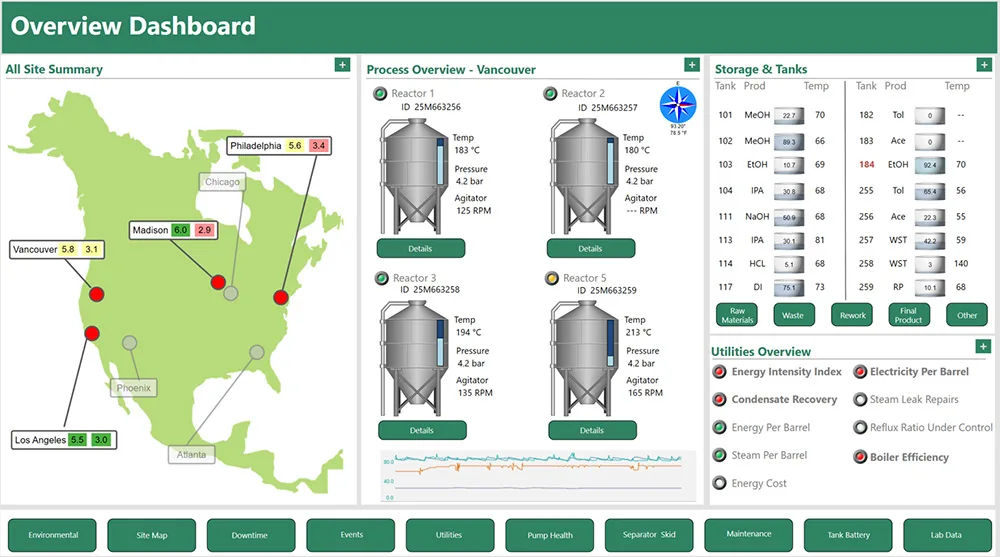
Graphics should be simple enough to build that engineers and operators can create them on their own without submitting an IT ticket.
Deployment flexibility matters.
Analysts have observed that manufacturers are being cautious with cloud-based software. Platforms that support on-premises, cloud, and hybrid deployment let manufacturers modernize at their own pace.
Historian vs. BI Tool vs. Industrial Data Intelligence Platform
Industrial data intelligence platforms are often confused with historians and business intelligence (BI) tools. Each serves a different purpose, and many manufacturers use all three together.
A data historian is built to collect and store high-frequency time-series data from control systems and devices, often at resolutions of seconds or less. Historians organize data by tag and are typically used by engineers and control system teams to retrieve past values and view basic trends. Their strength is reliable, efficient data capture, not analysis or context.
A BI tool is built for transactional and business data such as orders, costs, and inventory. BI tools are used by analysts, finance teams, and leadership to produce reports and KPI dashboards, usually on a daily, weekly, or monthly basis. They organize data around business entities like products and customers, and are not designed to handle high-frequency process data or the asset context engineers need.
An industrial data intelligence platform brings together time-series, event, batch, lab, and transactional data from across OT and IT systems. It organizes that data around asset hierarchies and production context, supports real-time monitoring and alerting, and provides engineering analysis, predictive models, and AI. Its users span engineering, operations, quality, maintenance, and leadership, and its output is insight and action rather than stored data or periodic reports.
Put simply, a historian answers the question “what happened?” A BI tool summarizes business performance over time. An industrial data intelligence platform connects plant and business data so teams can understand why performance changed and respond. Platforms can include a native historian, work with existing ones, and feed BI tools rather than replace them.
Thinking about an Industrial Data Intelligence Platform? Let our Smart Factory guide your way.
Core Capabilities of an Industrial Data Intelligence Platform
Not every product in the industrial data intelligence category is built the same way, but a complete platform should cover the following capabilities.
Data Connectivity and Integration
The platform should connect to the systems already in place, including historians, DCS and SCADA systems, PLCs, MES, LIMS, ERP, and IIoT devices. Broad connectivity through standard protocols and native connectors allows manufacturers to bring data together without replacing existing infrastructure.
Data Storage and Management
A platform needs a reliable way to store and serve time-series data at scale. That may mean a native historian, the ability to federate queries across existing historians, or both. Performance matters here, since engineers frequently query years of high-resolution data.
Contextualization and Asset Modeling
Raw tags are difficult to use without context. Asset hierarchies, tag mapping, and a unified namespace give data a consistent structure, organized by site, area, unit, and equipment. Context is what allows data to be compared across lines and sites, and what makes it usable for advanced analytics and AI.
Visualization and Trending
Engineers and operators need fast, flexible ways to see data. This includes time-series trending, process graphics that mirror the plant layout, and dashboards for monitoring key metrics. Visualization should support both real-time monitoring and historical investigation.
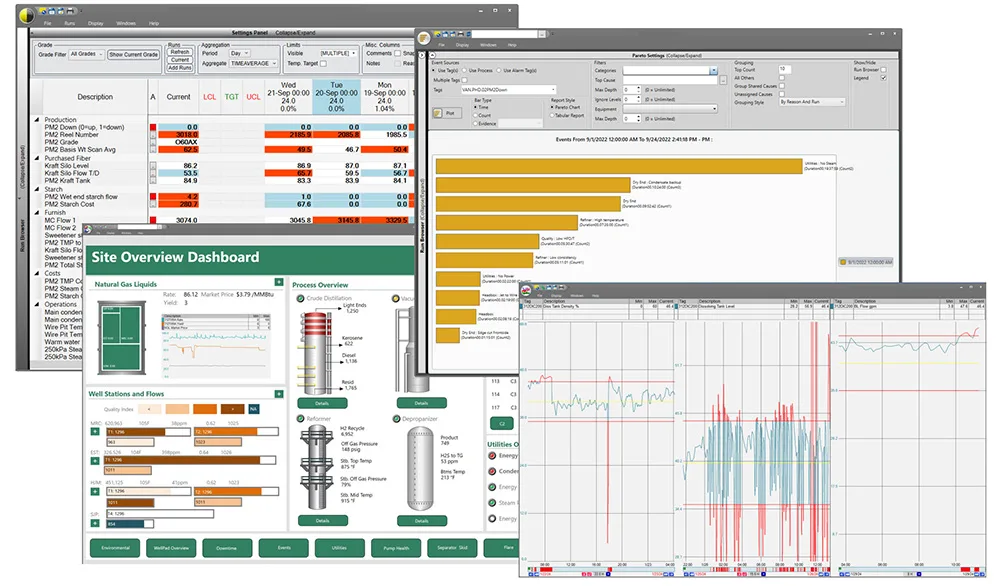
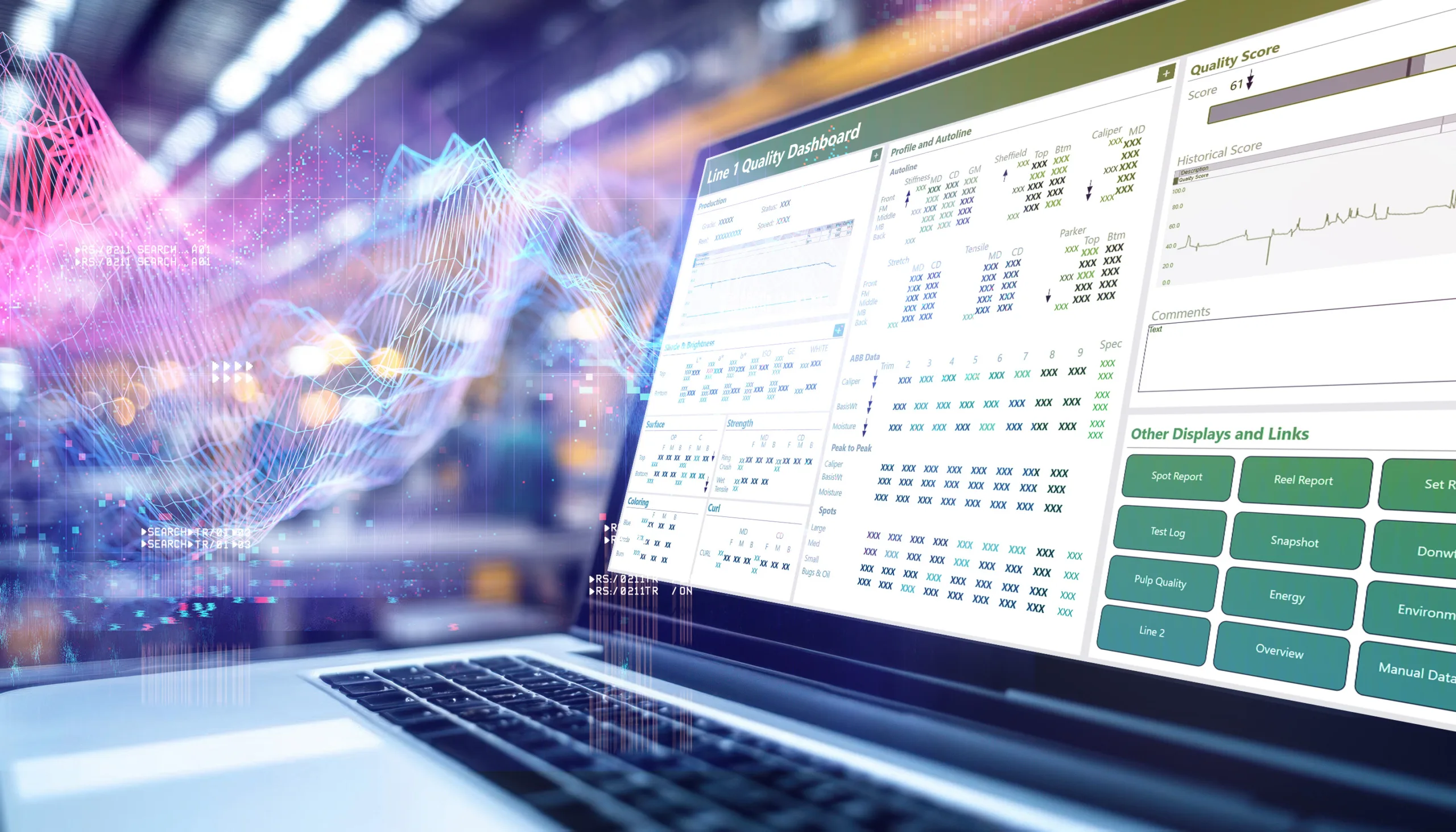
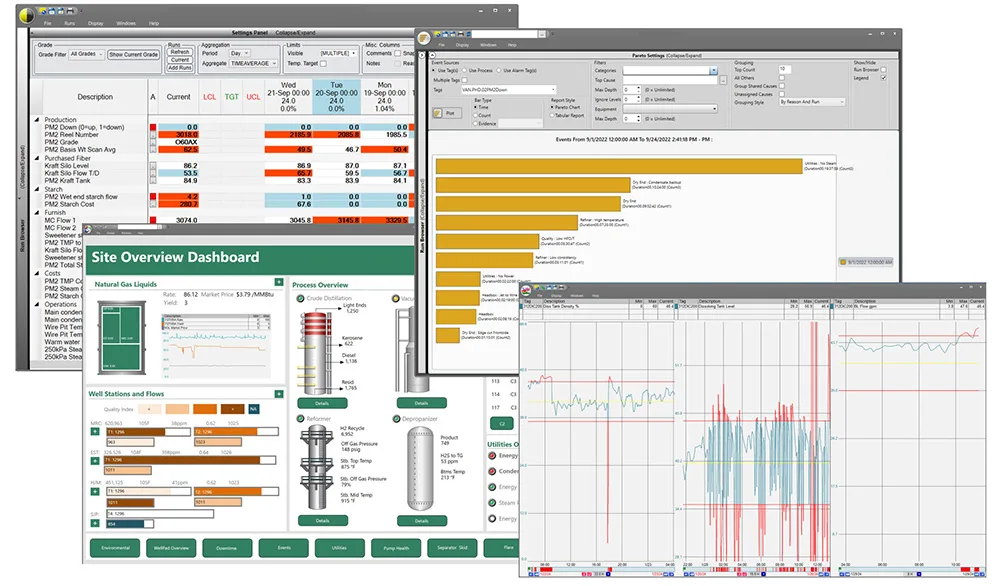
Dashboards, trending, run to run comparison analysis and more should be included in your industrial data intelligence software package.
Engineering Analysis Tools
Self-service analysis allows engineers to investigate problems without waiting on IT or exporting data to spreadsheets. Typical tools include statistical analysis, correlation, X-Y plots, golden batch comparison, and calculated tags.
Event and Performance Tracking
Manufacturers need to track production events such as downtime, grade changes, and batches, along with performance metrics like OEE value. Tying events to process data makes it possible to find the root causes of losses rather than just record them.
Alerting and Notification
Alerts based on process conditions, calculated values, or model outputs notify the right people when something changes, reducing the time between a process upset and a response.
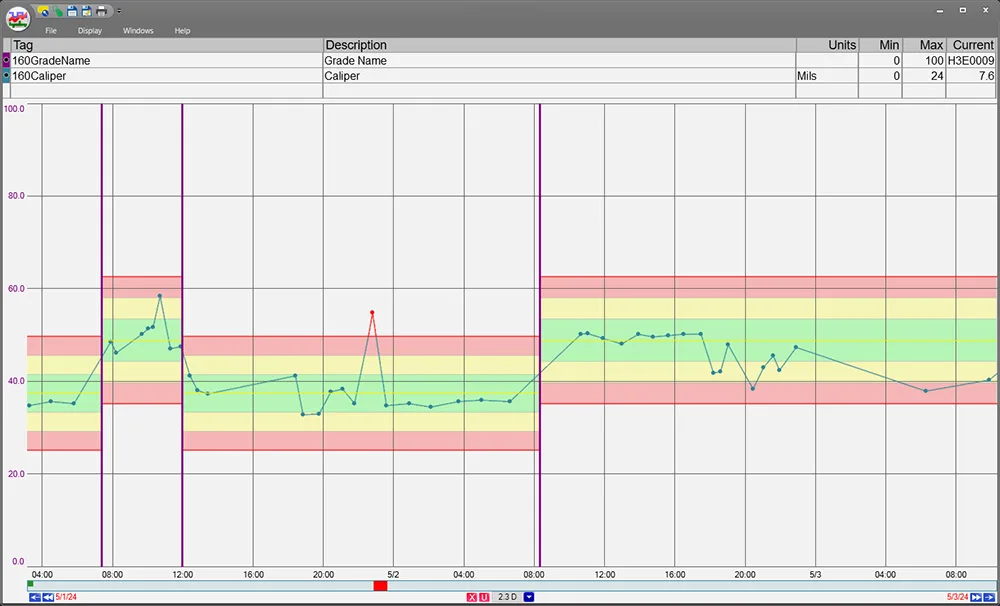
Grade based limits allows operators to see when values are out of spec even as the process conditions change, without manually adjusting the trend each time.
Collaboration and Reporting
Shared displays, annotations, and scheduled reports help teams communicate findings across shifts, departments, and sites.
Enterprise Scale and Security
A platform should support multi-site deployment, role-based access control, and flexible deployment models, including on-premises, cloud, and hybrid options. Security and scalability determine whether a platform can grow from a single plant to an entire enterprise.
What Making the Move Looks Like
Moving to an industrial data intelligence platform rarely requires replacing existing systems. Most manufacturers take a phased approach that builds on the infrastructure already in place.
The first step is typically connecting existing historians, control systems, and plant databases so data is accessible from one environment. Next comes contextualization: organizing tags into asset hierarchies and applying consistent naming so data can be compared across units and sites. With that foundation in place, teams can roll out visualization and self-service analysis to engineers and operators, then layer in event tracking, predictive analytics, and AI as use cases mature.
Starting with a single site or a high-value process area allows teams to prove results before scaling across the enterprise.
How dataPARC Approaches Industrial Data Intelligence
dataPARC provides an industrial data intelligence platform built for process and manufacturing engineers. PARCview handles data integration, connecting to existing historians as well as delivering trending, process graphics, dashboards, and engineering analysis tools. The dataPARC historian is available for connecting to data and storage if needed. PARCview Nexus provides connectivity and contextualization across data sources in a web-browser.
Together, these products allow manufacturers to work with the systems they already have while building the data foundation needed for advanced analytics and AI. To learn more, request a demo.
Frequently Asked Questions
- What is an industrial data intelligence platform?
An industrial data intelligence platform is software that collects, contextualizes, and analyzes operational data from across a manufacturing operation. It combines data integration, storage, visualization, and analytics so teams can turn plant data into decisions. - Is an industrial data intelligence platform the same as a historian?
No. A historian collects and stores time-series data. An industrial data intelligence platform may include a historian or connect to existing ones, and adds integration, context, analysis, and visualization on top of that data. - Can an industrial data intelligence platform replace BI tools?
Usually not, and it does not need to. BI tools are built for business reporting, while industrial data intelligence platforms are built for high-frequency operational data. Many manufacturers use a platform to prepare and contextualize plant data, then pass summarized results to BI tools. - How does an industrial data intelligence platform support AI in manufacturing?
AI models need clean, contextualized, and accessible data to produce reliable results. An industrial data intelligence platform provides that foundation by integrating data sources, applying asset context, and making historical and real-time data available for modeling.
Building The Smart Factory
A Guide to Technology and Software in Manufacturing for a Data-Drive Plant