Case Study
Palm Paper
Learn how Palm Paper replaced a patchwork of spreadsheets and disconnected trending tools with dataPARC, driving mill-wide adoption through centerlined grade changes and real-time heat exchanger monitoring that cut waste and saved 4 tons/hour of steam.
Background
Palm Paper is part of the Palm Group, one of Europe’s largest family owned paper businesses. The Kings Lynn mill in the UK operates a highly automated machine that produces newsprint and a mix of specialty and packaging grades from 100 percent recycled fiber. As the product mix expanded and energy costs rose, the mill needed a better way to use its data to support grade changes, improve runnability, and reduce energy and material usage.
“Before dataPARC, we had trending here, a report there, and no single historian. You were pulling data from all sorts of places and building spreadsheets. It was a hassle every day.”
Robin Linney, Managing Director at Palm Paper
Palm’s Pain Points
No unified historian and limited tools for continuous improvement. Unlike many larger groups, Palm did not have a global IT/OT strategy or a standard data historian. Each mill coped with its own mix of DCS trends, lab systems, and external analysis tools.
For the Kings Lynn mill, this created several challenges:
- No single, trusted source of process history
- Manual effort to assemble data for troubleshooting or improvement projects
- Difficulty managing large numbers of grades and frequent grade changes
- Limited visibility into control loop performance and energy usage
- Reliance on a few experts and external tools for advanced analysis
The team knew from experience at other mills that a modern historian and analysis platform could deliver fast payback. Initially, they assumed they would standardize on PI, but a wider evaluation led them to dataPARC.
“We wanted everybody to use it. Most people are using dataPARC all of the time now. We hardly ever use DCS trending anymore. We just use dataPARC.”
Robin Linney, Managing Director at Palm Paper
dataPARC in Action: Everyday Use Cases
Centerlining To Support Frequent Grade Changes
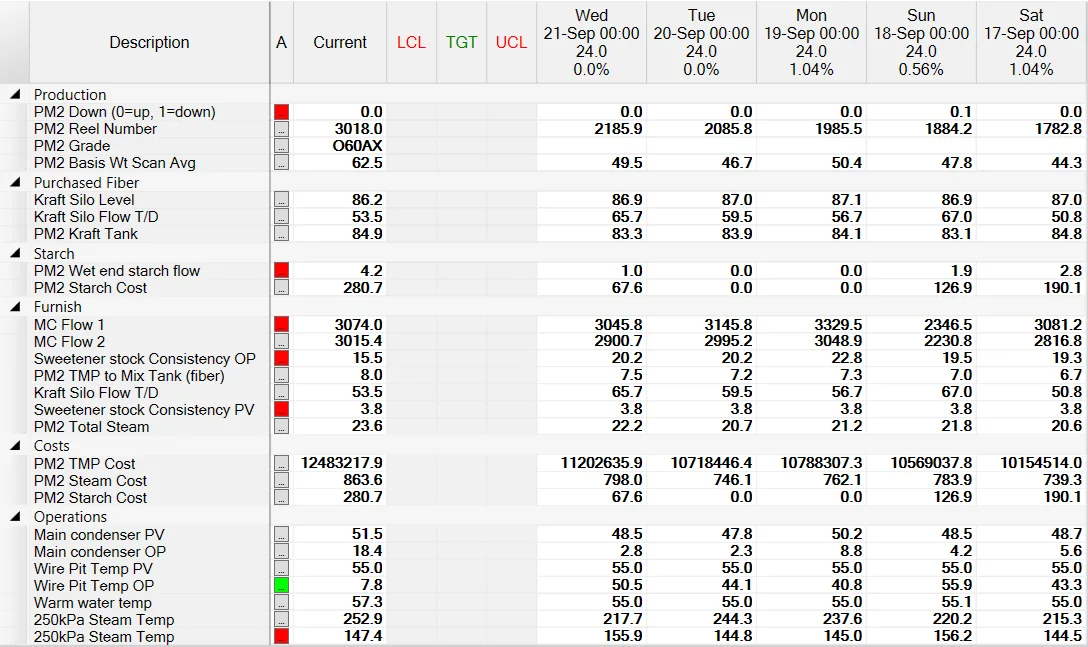
With a broad product mix and constant grade adjustments, Palm needed a simple way to keep machine settings aligned. Using dataPARC, the team built a central centerline table that drives grade targets and limits across the mill. When a spec changes, engineers update a single table with a digital sign-off and reason. The change automatically cascades to screens, trends, and quality standards.
Operators see:
- Current machine parameters
- Target values and control limits for the active grade
- Values from previous runs of the same grade for quick comparison
- Automatic visual warnings when parameters move out of spec
- These centerline displays in daily morning meetings to review performance.
Results:
- Less confusion during grade changes
- Reduced waste and improved runnability
- Clear, consistent targets for operators across all shifts
Heat Exchanger Efficiency and Steam Savings
The mill operates multiple heat exchangers, including units that recover heat from effluent to warm incoming process water. Responsibility for these exchangers had historically fallen between departments, and there was no easy way to see whether they were running efficiently.
Using dataPARC, the team:
- Implemented efficiency calculations based on standard heat-exchanger tables
- Built dashboards that display the efficiency of each exchanger in real time
- Tracks when efficiency drops and flags units that need cleaning
- Combined with dataPARC’s cleaning and filtering tools for trends, this gave a clear visual of steam demand before and after cleaning.
Results:
- About four tons per hour of steam savings when heat exchangers are kept at high efficiency
- Clear ownership and visibility for equipment that previously “fell between the cracks”
Impact
While Palm has not tried to calculate a single global ROI, individual projects demonstrate strong payback:
- About four tons per hour steam reduction linked to heat exchanger monitoring
- Around six percent starch savings after tuning with Control Suite
- Avoided failures and downtime through proactive alerts on critical assets
- Reduced grade change waste and more stable quality through centerlining
- Widespread adoption across production, engineering, and support teams
More Success Stories

Drax Biomass
See how Drax Biomass developed an organization-wide data management strategy for their pellet production operations.

Energy Transfer
See how Energy Transfer underwent a complete digital transformation, saving them time, money, and enabling better decision-making.

Western Plains Energy
See how Western Plains Energy developed data-driven insights and improved product quality and process efficiency at their ethanol plant.
Palm Paper Case Study
Download the case study to see how Palm Paper replaced a patchwork of spreadsheets and disconnected trending tools with dataPARC, driving mill-wide adoption through centerlined grade changes and real-time heat exchanger monitoring that cut waste and saved 4 tons/hour of steam.